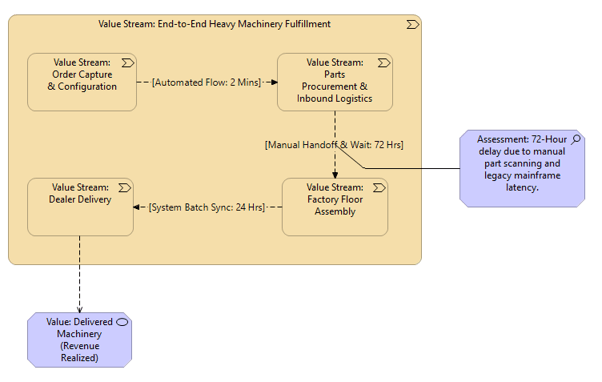
What it shows:
The end-to-end, step-by-step sequence of activities required to deliver a specific product, service, or piece of value to a customer. Crucially, it maps not just the actions, but the time delays, manual hand-offs, and information flows between each step.
Why it’s needed:
Bottleneck identification and ROI justification. This is the primary tool for showing exactly where current operations are bleeding efficiency. By mapping the “As-Is” state (full of delays) against the proposed “To-Be” state (streamlined by software or a PoC), it provides undeniable mathematical proof of the return on investment.
When to use it:
Highly recommended during pre-sales pitches, Proof of Concept (PoC) engagements for proprietary software, or any project involving Business Process Re-engineering (BPR). If the goal is to fundamentally change how a business works or replace a legacy process, this map is required to make the business case.
When NOT to use it:
Generally best to omit for standard COTS deployments or pure backend infrastructure refreshes where the operational efficiency is already accepted. If the project’s mandate is to support existing workflows without analysing or changing them, mapping the value stream is completely out of scope.
Example: